
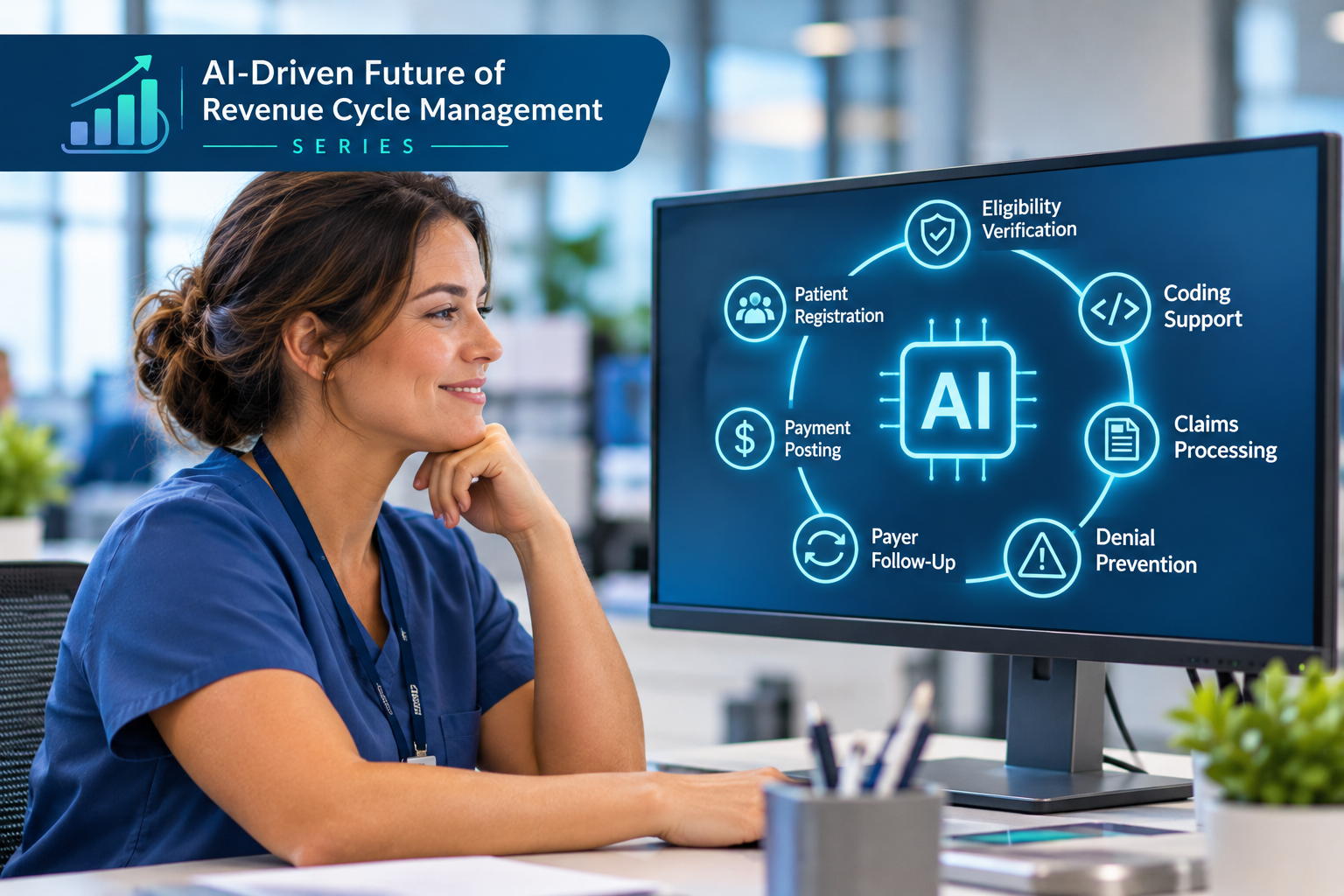
The Future of RCM: Near-Touchless Practice Management Through AI Automation
Part 5 of the “AI-Driven Future of Revenue Cycle Management” series by Jason McNeil, Experity EVP of Revenue Cycle Management
Revenue cycle management (RCM) is entering a new era. For years, healthcare organizations have invested in digital workflows, automation tools, and analytics to reduce administrative burden and improve reimbursement performance. Yet many practice management (PM) workflows still depend on manual intervention, with staff touching claims multiple times before payment arrives.
Artificial intelligence (AI) is beginning to change that model.
The future of RCM is a near-touchless PM environment where AI automates large portions of the claims lifecycle. From patient registration to final payment posting, intelligent systems can identify errors, predict denials, automate follow-up tasks, and optimize reimbursement with minimal human intervention. The result is a faster, more accurate, and more scalable revenue cycle.
For urgent care organizations and ambulatory practices, this shift presents a strategic opportunity to improve financial performance while reducing operational strain.
Why Traditional Claims Workflows Create Friction
Most healthcare organizations still manage claims through fragmented workflows. Staff members manually review eligibility, correct coding issues, submit claims, monitor payer responses, and rework denials. Even highly efficient teams experience delays caused by missing or incomplete patient data, eligibility mismatches, coding inconsistencies, payer-specific rule changes, manual claim status checks, delayed denial identification, and repetitive follow-up tasks.
These processes consume valuable staff time and increase the risk of preventable denials and delayed reimbursement.
As labor shortages continue across healthcare, many organizations cannot solve these challenges simply by adding staff. RCM leaders need systems that automate repetitive work and allow employees to focus on high-value exceptions.
What Near-Touchless PM Means
A near-touchless PM model reduces the number of manual interactions required throughout the claims lifecycle while maintaining human oversight.
In this model, AI continuously monitors workflows, identifies risks, and completes routine actions automatically. Human intervention occurs when the system detects an exception that requires review or escalation.
A near-touchless claims lifecycle may include:
- Automated eligibility verification before the visit
- Real-time coding recommendations during documentation
- AI-driven claim scrubbing before submission
- Predictive denial prevention
- Automated payer follow-up workflows
- Intelligent payment posting
- Continuous analytics and workflow optimization
The goal is operational efficiency with intelligent oversight.
How AI Is Transforming the Claims Lifecycle
AI-driven automation can impact every stage of RCM, with the greatest value coming from connecting these workflows into a unified ecosystem.
Front-End Automation Improves Claim Accuracy
Errors that occur at registration often create downstream reimbursement problems. AI tools can reduce these issues before the claim is generated.
Modern AI systems can verify insurance eligibility in real time, detect incomplete demographic information, flag authorization requirements, predict patient responsibility, and recommend corrections before check-in is complete.
These capabilities can improve clean claim rates and reduce avoidable denials.
Intelligent Coding Supports Compliant Reimbursement
Coding complexity continues to increase. AI-assisted coding tools can analyze clinical documentation and recommend appropriate CPT and ICD-10 codes based on payer rules and historical trends.
This technology helps organizations reduce undercoding and missed revenue, improve coding consistency, identify documentation gaps, accelerate claim preparation, and support compliance initiatives.
Predictive Analytics Reduce Denials Before Submission
Traditional denial management focuses on rework after rejection. AI allows healthcare RCM teams to identify potential issues earlier in the claims lifecycle.
Machine learning models can analyze historical claims data to identify patterns associated with denials. These systems can predict whether a claim is likely to be denied before submission.
AI-Powered Automation Accelerates Payer Follow-Up
Manual claim follow-up remains one of the most labor-intensive RCM functions. Staff often spend hours checking claim status, documenting payer responses, and managing repetitive tasks.
AI-enabled workflow automation can monitor claim aging automatically, trigger follow-up actions based on payer behavior, prioritize high-risk accounts, generate escalation workflows, and route exceptions to the appropriate team members.
Intelligent Payment Posting Closes the Loop Faster
Payment posting is another area where healthcare RCM automation can create measurable efficiency gains.
AI-driven payment posting systems can match electronic remittance advice (ERA) data automatically, detect payment discrepancies, reconcile underpayments, identify contract variance issues, and post payments with minimal manual intervention.
The Human Role in a Near-Touchless Future
Automation changes where experienced RCM professionals focus their time and expertise.
In a near-touchless PM environment, staff members can shift toward exception management, financial strategy, payer relationship oversight, compliance monitoring, workflow optimization, and patient financial engagement.
Challenges Organizations Must Address
Although the future of AI-enabled RCM is promising, successful adoption requires careful planning.
Healthcare organizations must address several challenges, including data quality, workflow integration, change management, compliance, security, and vendor alignment.
What the Future Looks Like
The next generation of healthcare RCM technology will combine AI, automation, analytics, and interoperability into a unified financial ecosystem.
In the future, healthcare organizations may operate with real-time reimbursement intelligence, self-correcting claims workflows, automated denial prevention, predictive cash flow forecasting, minimal manual claims intervention, faster patient financial communication, and greater operational scalability.
The Path Forward for Urgent Care Organizations
Urgent care organizations face unique operational pressures. High patient volumes, fast visit turnover, evolving payer requirements, and staffing constraints create constant demands on revenue cycle teams.
AI-powered RCM automation can help organizations respond more effectively by increasing clean claim rates, reducing denial volumes, accelerating reimbursement, lowering administrative costs, improving staff efficiency, and enhancing financial visibility.
As AI in healthcare RCM continues to advance, organizations can create more efficient workflows that allow healthcare teams to work faster, more accurately, and with greater strategic focus.
Near-touchless PM represents the next evolution of operational efficiency in healthcare revenue cycle management.
As providers adopt AI-driven automation, payers are also deploying AI aggressively to review, flag, and deny claims faster than ever before.
This article is part of the “AI-Driven Future of Revenue Cycle Management” series exploring how artificial intelligence is transforming healthcare billing, reimbursement, and operational strategy.